

813661-B21 HPE Ethernet 10Gb 2-port 535T BASE-T BCM57416 Adapter
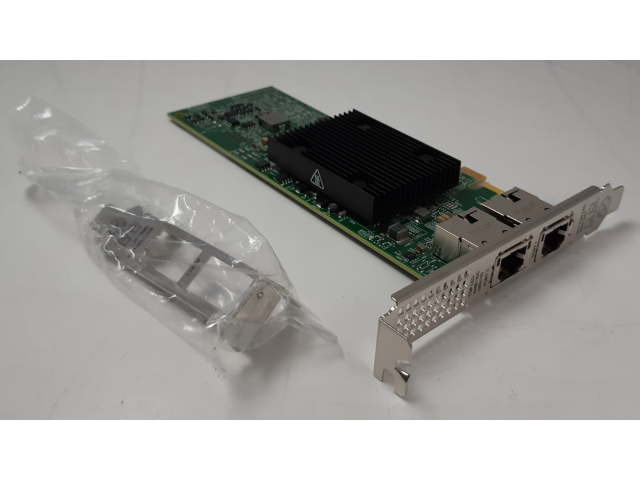


- Ethernet 10Gb 2-port 535-T Adapter
- Two (2) 10Gb ports (RJ45) - each at 20 Gbps bi-directional; 40 Gbps bi-directional theoretical bandwidth
- Broadcom BCM57416
- With High- and Low-Profile bracket
- Photos are indicative and may differ. SpareIT tries to represent this as correctly as possible.
Disclaimer:
Product photos and specifications are made available by Universal Databases and are often based on new products.
When the item is a 'Refurbished product' it has been tested by us and has an A-grade condition (unless otherwise stated). Refurbished items do not include cables, software media and manuals (unless otherwise stated).
Please read the product description carefully and contact us if you have any questions.
Description
Option Part Number: 813661-B21
Spare Part Number: 815669-001
General
Device Type: Network Adapter
Adapter Type: Ethernet 10Gb 2-Port 535T Adapter
Network Processor: Broadcom BCM57416 (BCM957416A4160C)
Data Rate: 2 port, each at 20 Gb bidirectional, 40 Gb bidirectional per adapter
Bus Type: PCIe 3.0 x8
Form Factor: Stand up (comes with Both Brackets)
IEEE Compliance: 802.3ae, 802.1Q, 802.3x, 802.1p, 802.3ad, 802.1AB, 802.1Qbg, 802.1Qbb
Jumbo Frames: 9600 KB
Networking
Data Link Protocol: 10 GigE
Data Transfer Rate: 10 Gbps
Ports: 2
Expansion & Connectivity
Expansion Slots: 2 (total) / 2 (free)
Power
Max Power Requirement: 19.60 Watt
Typical Power Requirement: 14.64 Watt
Product Dimensions & Weight
Width: 9.84 inch
Height: 8.46 inch
Depth: 2.36 inch
Weight: 0.635 lbs
Environmental Parameters
Operating Temperature: 0° to 55°C (32° to 131°F)
Non-Operating Temperature: -65° to 85° C (-85° to 185° F)
Operating Humidity: 10% to 90% non-condensing
Non-Operating Humidity: 5% to 95% non-condensing
Compatibility Information
Designed for
HPE ProLiant DL Series: DL20 Gen10, DL120 Gen10, DL160 Gen10, DL180 Gen10, DL360 Gen10, DL380 Gen10, DL560 Gen10, DL580 Gen10, DL385 Gen10, DL325 Gen10 Servers
HPE ProLiant ML Series: ML110 Gen10, ML30 Gen10, ML350 Gen10 Servers
HPE Apollo 2000 XL170r Gen10, XL190r Gen10 Servers
HPE Apollo 4500 XL450 Gen10 Server
HPE Apollo 6000 XL230k Gen10 Server
Features
Audit Logs
Audit Logs are a forensics capability that provides traceability into authenticated firmware updates by capturing changes in standard system logs.
Authenticated Updates
Authenticated Updates brings cryptographic keys onto the NIC (for HW Authentication) to protect user and configuration data from unauthorized access and verify digitally signed firmware.
Checksum & Segmentation Offload
Normally the TCP Checksum is computed by the protocol stack. Segmentation Offload is technique for increasing outbound throughput of high-bandwidth network connections by reducing CPU overhead. The technique is also called TCP segmentation offload (TSO) when applied to TCP, or generic segmentation offload (GSO).
Configuration Utilities
This adapter ships with a suite of operating system-tailored configuration utilities that allow the user to enable initial diagnostics and configure adapter teaming. This includes a patented teaming GUI for Microsoft Windows operating systems. Additionally, support for scripted installations of teams in a Microsoft Windows environment allow for unattended OS installations.
Device-level Firewall
Device-level Firewall blocks any unmanaged access to memory or storage. This ensures that on-device firmware and configuration data can only be accessed by authorized agents.
DPDK
This adapter supports DPDK with benefit for packet processing acceleration and use in NFV deployments.
HPE Sea Of Sensors 3D
Support for the HPE Sea of Sensors which is a collection of 32 sensors that automatically track thermal activity - heat - across the server. When temperatures get too high, sensors can initiate fans and make other adjustments to reduce energy usage. A significant improvement lies in the ability to apply fan speed increases only to the portion of the system that is rising in temperature, rather than all six fans in unison, which reduces the amount of energy used for cooling.
HW (Hardware and Firmware) Root of Trust
Root of Trust enables a chain of trust for Authenticating updates to firmware via signature validation. This blocks installation of rogue or corrupted firmware and ensures that the executing firmware is trusted.
IPv6
IPv6 uses 128-bit addressing allowing for more devices and users on the internet. IPv4 supported 32-bit addressing.
Jumbo Frames
This adapter supports Jumbo Frames (also known as extended frames), permitting up to a 9,600 byte (KB) transmission unit (MTU) when running Ethernet I/O traffic. This is over five times the size of a standard 1500-byte Ethernet frame. With Jumbo Frames, networks can achieve higher throughput performance and greater CPU utilization. These attributes are particularly useful for database transfer and tape backup operations.
Message Signaled Interrupt (MSIX)
Message Signaled Interrupt provides performance benefits for multi-core servers by load balancing interrupts between CPUs/cores.
Network Adapter Teaming
This adapter support for NIC teaming helps IT administrators increase network fault tolerance and increased network bandwidth, the team of adapters can work together as a single virtual adapter, providing support for several different types of teaming enabling IT administrators to optimize availability, improve performance and help reduce costs.
Network Partitioning (NPAR)
This adapter supports Network Partitioning (NPAR) allowing administrators to configure a 10 Gb port as four separate partitions or physical functions. Each PCI function is associated with a different virtual NIC. To the OS and the network, each physical function appears as a separate NIC port.
Optimized for Virtualization
I/O Virtualization support for VMware NetQueue and Microsoft VMQ helps meet the performance demands of consolidated virtual workloads.
LED Indicators
LED indicators show link integrity and network activity for easy troubleshooting.
Preboot eXecution Environment (PXE)
Support for PXE enables automatic deployment of computing resources remotely from anywhere. It allows a new or existing server to boot over the network and download software, including the operating system, from a management/ deployment server at another location on the network.
Additionally, PXE enables decentralized software distribution and remote troubleshooting and repairs.
RDMA
Remote Direct memory Access (RDMA) is an accelerated I/O delivery mechanism that allows data to be transferred directly from the user memory of the source server to the user memory of the destination server bypassing the operating system (OS) kernel.
Because the RDMA data transfer is performed by the DMA engine on the adapter's network processor, the CPU is not used for the data movement, freeing it to perform other tasks such as hosting more virtual workloads (increased VM density). RDMA protocols include RoCEv1, RoCEv2 and iWARP. All of these protocols reduce overall latency to deliver accelerated performance for applications such as Microsoft Hyper-V Live Migration, Microsoft SQL and Microsoft SharePoint with SMB Direct.
Receive Side Scaling (RSS)
RSS resolves the single-processor bottleneck by allowing the receive side network load from a network adapter to be shared across multiple processors. RSS enables packet receive-processing to scale with the number of available processors.
Sanitization
Sanitization (Secure User Data Erase) renders User and configuration data on the NIC irretrievable so that NICs can be safely repurposed or disposed.
Secure Boot
Secure Boot safeguards the system and ensures no rogue drivers are being executed on start-up.
Server Integration
This adapter is a validated, tested, and qualified solution that is optimized for HPE ProLiant servers. Hewlett Packard Enterprise validates a wide variety of major operating systems drivers with the full suite of web-based enterprise management utilities including HPE Intelligent Provisioning and HPE Systems Insight Manager that simplify network management. This approach provides a more robust and reliable networking solution than offerings from other vendors and provides users with a single point of contact for both their servers and their network adapters.
Single-Root I/O Virtualization
Single-Root I/O Virtualization (SR-IOV) provides a mechanism to bypass the host system hypervisor in virtual environments providing near metal performance and server efficiency. SR-IOV provides mechanism to create multiple Virtual Functions (VFs) to share single PCIe resources. The device is capable of SR-IOV, and requires Server BIOS support, controller firmware, and OS support.
TCP/UDP/IP
For overall improved system response, this adapter supports standard TCP/IP offloading techniques including: TCP/IP, UDP checksum offload (TCO) moves the TCP and IP checksum offloading from the CPU to the network adapter. Large send offload (LSO) or TCP segmentation offload (TSO) allows the TCP segmentation to be handled by the adapter rather than the CPU.
Tunnel Offload
Minimize the impact of overlay networking on host performance with tunnel offload support for VXLAN, NVGRE and GENEVE. By offloading packet processing to adapters, customers can use overlay networking to increase VM migration flexibility and virtualized overlay networks with minimal impact to performance. HPE Tunnel Offloading increases I/O throughput, reduces CPU utilization, and lowers power consumption. Tunnel Offload supports VMware's VXLAN, Microsoft's NVGRE solutions and Generic Network Virtualization Encapsulation (GENEVE) solutions.
VMware NetQueue and Microsoft Virtual Machine Queue (VMQ)
VMware NetQueue is technology that significantly improves performance of 10 Gigabit Ethernet network adapters in virtualized environments. Windows Hyper-V VMQ (VMQ) is a feature available on servers running Windows Server 2008 R2 with VMQ-enabled Ethernet adapters. VMQ uses hardware packet filtering to deliver packet data from an external virtual machine network directly to virtual machines, which reduces the overhead of routing packets and copying them from the management operating system to the virtual machine.
Specifications
| Other features | |
|---|---|
| Ports quantity | 2 |
| Harmonized System (HS) code | 85176990 |
| Quantity per pack | 1 pc(s) |
| Performance | |
| Compatible products | HPE ProLiant |
| Design | |
| Component for | Server |
| Power | |
| Power consumption (typical) | 14.64 W |
| Networking | |
| Networking standards | IEEE 802.1Q, IEEE 802.1Qau, IEEE 802.1Qaz, IEEE 802.1Qbb, IEEE 802.1Qbg, IEEE 802.1p, IEEE 802.3ae, IEEE 802.3an, IEEE 802.3az, IEEE 802.3x |
| Ethernet interface type | 10 Gigabit Ethernet |
| Ethernet LAN data rates | 10000 Mbit/s |
| Ethernet LAN | Yes |
| Chipset | Broadcom BCM57416 |
| Bandwidth | |
| Data transfer rate (max) | 10 Mbit/s |
| Ports & interfaces | |
| Ethernet LAN (RJ-45) ports | 2 |
| HDD interface | Ethernet |
| Host interface | PCI Express |
| Internal | Yes |
| Connectivity technology | Wired |


